Observe|观察 Read photographs as primary-source evidence rather than decoration.
Interpret|解读 Connect slogan language with policy priorities and social mentality.
Evaluate|评估 Distinguish visible evidence, reasonable inference, and verified fact.
Step 1 — First Encounter|第一次观看
Before reading dates or background: Examine this complete photo set silently. Record only what the images themselves allow you to observe. Larger versions and their visible wording appear in Step 2.
Photo 1|照片一
Photo 2|照片二
Photo 3|照片三
Photo 4|照片四
Photo 5|照片五
Photo 6|照片六
Photo 7|照片七
Photo 8|照片八
Photo 9|照片九
What repeats across the photographs? 这些照片中反复出现了哪些视觉或语言特点?
What appears to change? 哪些内容似乎发生了变化?
Which slogan feels most persuasive, promising, or reassuring? 哪条标语最像是在劝说、承诺或安慰?为什么?
Which slogan feels most coercive? 哪条标语的强制意味最明显?哪些词造成了这种感觉?
Step 2 — Read the Photo Evidence|阅读照片证据
Evidence rule: “Visible in the photograph” does not automatically mean “officially authorized,” and a repost date is not the date the slogan was painted. Dates and locations remain provisional until supported by reliable provenance.
Source note|来源说明: This photograph collection was assembled for teaching over more than thirty years. For some older photographs, the original photographer, publication source, date, and location could not be reliably reconstructed. These photographs are presented here in direct connection with nonprofit educational criticism, commentary, historical inquiry, and language learning. CPL does not claim ownership of third-party photographs. If you can provide reliable source information, identify a rights holder, or request review of an image’s use, please contact the CPL website.
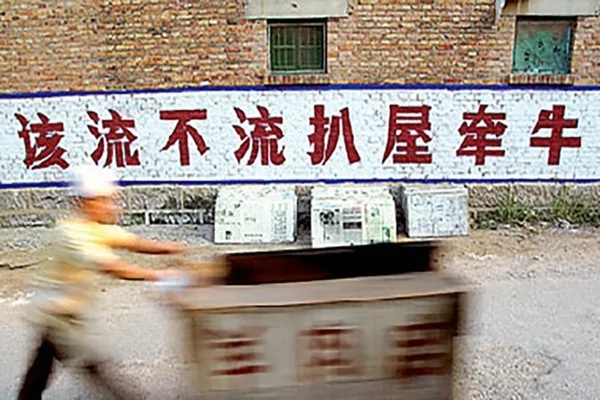
该流不流,扒屋牵牛
Visible wording|照片可见文字
Restriction discourseCoercion / punishment
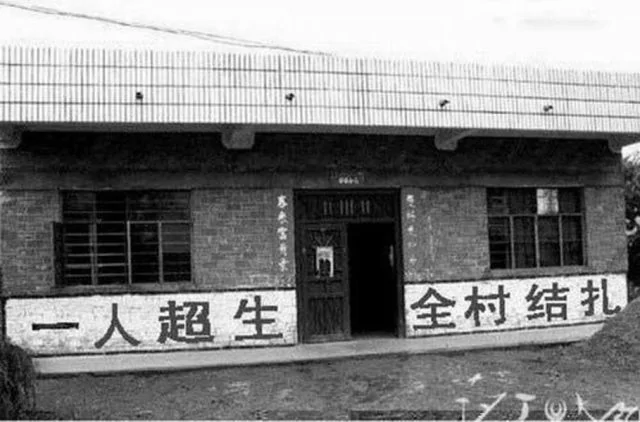
一人超生,全村结扎
Visible wording|照片可见文字
Restriction discourseCollective consequence
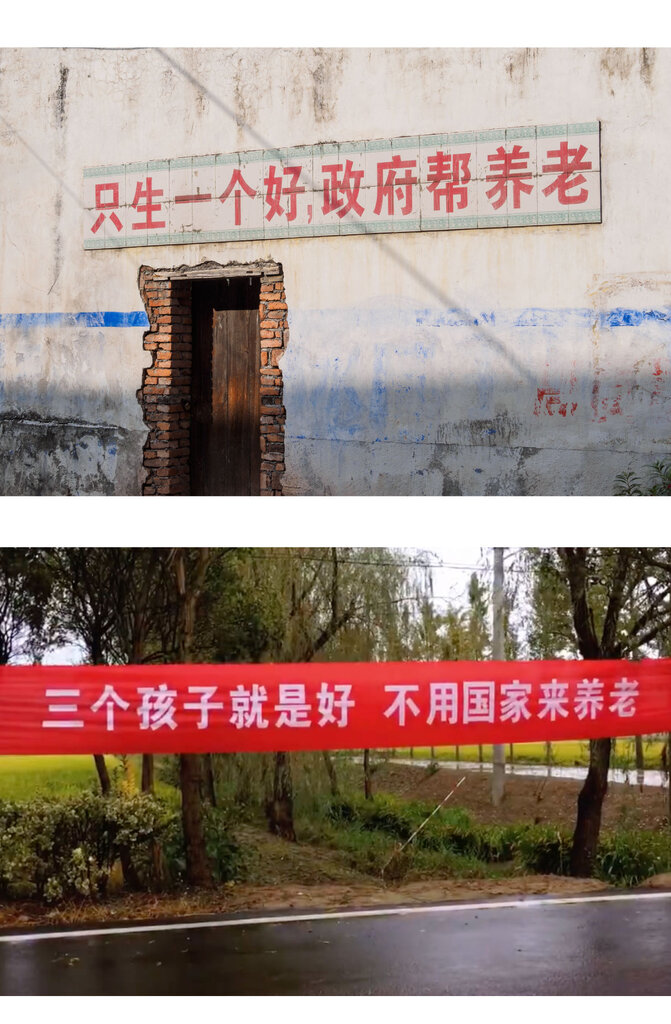
只生一个好,政府帮养老
三个孩子就是好,不用国家来养老
A useful composite image, but each component requires separate source verification.
PromiseHistorical reversal
少生优生,幸福人生
Visible wording|照片可见文字
Restriction discourseHappiness framing
少生优育,利国利民
Visible wording|照片可见文字
Public benefitMoral appeal
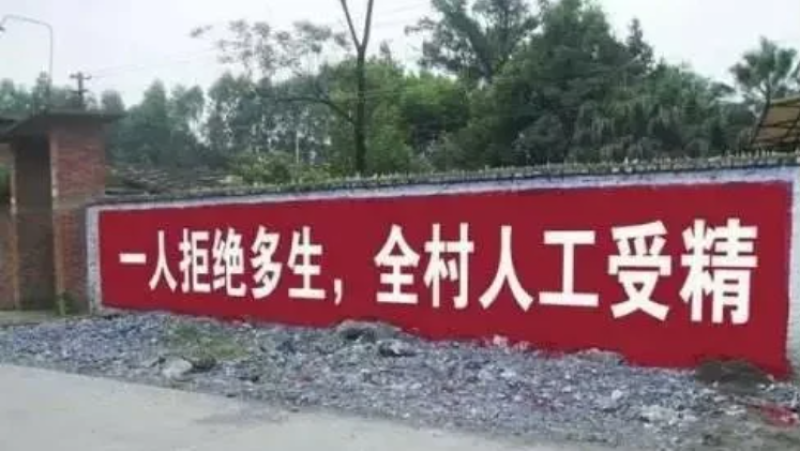
一人拒绝多生,全村人工受精
Visible wording; origin and authorization require verification.
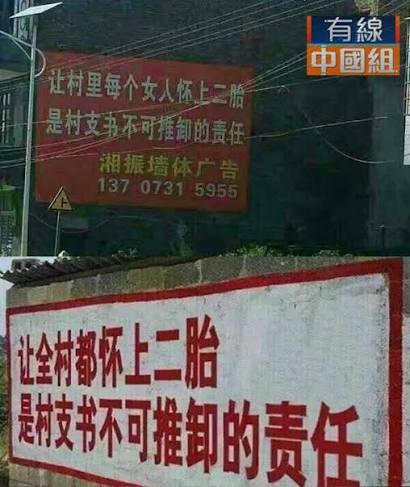
Lower wall text. The upper sign uses a related but not identical formulation.
Birth-promotion discourseOfficial responsibility
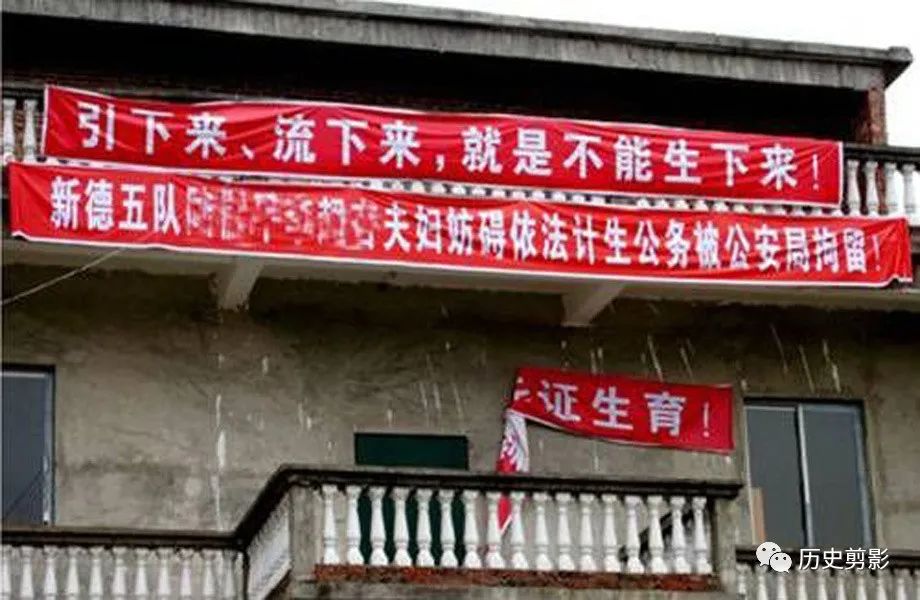
引下来、流下来、就是不能生下来!
新德五队XXX夫妇妨碍依法计生公务被公安局拘留!
Visible wording; identifying names are unclear in the supplied image.
Restriction discoursePunitive public notice
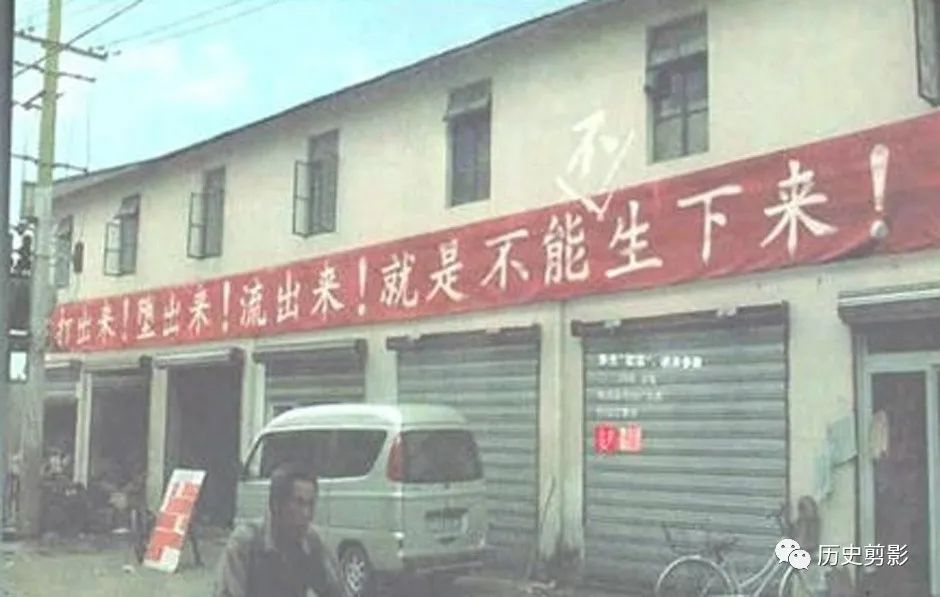
打出来!堕出来!流出来!就是不能生下来!
A handwritten “不” added after “不能” changes the final clause to “就是不能不生下来!”—a local rejection of the original coercive message. The photograph does not identify who added it or exactly when.
Restriction discourseLocal rejection
Reading local rejection|解读民间拒斥: In Photo 9, how does the added “不” reverse the final clause and reject the original coercive message? What does this small intervention reveal about the gap between official language and local response? What can the photograph establish, and what remains uncertain? 照片九中,后来加上的“不”怎样逆转了最后一句的意思,并表达当地人对原有强制性口号的拒斥?这一细小改动怎样显示官方话语与民间回应之间的距离?照片能够证明什么?哪些问题仍无法确定?
Step 3 — Build the Policy Timeline|建立政策时间线
Policy phase
Demographic goal
Representative language
Provisional dating note
Birth restriction|限制生育
Reduce births and control population growth
该流不流;一人超生;只生一个;少生优生/优育;就是不能生下来;被公安局拘留
Do not label every example “1970.” Several formulations align more closely with the late-1970s and later family-planning era.
Universal two-child era|全面二孩
Encourage eligible families to have a second child
怀上来,生出来,养起来;怀上二胎
Policy phase beginning in 2016; the individual photograph still requires its own date and provenance.
Three-child era|三孩政策
Encourage larger families amid demographic change
三个孩子就是好
Belongs to the policy environment beginning in 2021, not the 2016 two-child phase.
Policy language and public response|政策话语与民间回应: Photo 8 adds evidence of coercive enforcement language to the birth-restriction phase. In Photo 9, the handwritten “不” is a local rejection of the original slogan—not a new policy slogan or a separate policy phase. Treat it as evidence of public response, and do not use the alteration alone to date the photograph. 照片八为限制生育阶段补充了强制执行话语的证据。照片九中手写添加的“不”是当地人对原标语的拒斥,并非新的政策口号或独立的政策阶段。应将其视为民间回应的证据,也不能仅凭这一改动判断照片的具体年代。
Timeline inference: What demographic concern appears to replace the earlier concern about population growth?
Step 4 — Mirror the Language|镜像语言比较
Earlier formulation
Later formulation
What changes?
What remains?
一人超生,全村结扎
一人拒绝多生,全村人工受精
The desired reproductive behavior reverses.
“一人……全村……” assigns collective consequences to an individual act.
只生一个好,政府帮养老
三个孩子就是好,不用国家来养老
One child becomes three; the promise of state support becomes family self-support.
Family size is linked rhetorically to old-age security.
Local cadres prevent unauthorized births
村支书 is responsible for promoting second births
The administrative target reverses.
Reproduction remains framed as a local governance responsibility.
Lexical reversal|词汇逆转 Circle or list words that reverse direction: 少/多, 超生/拒绝多生, 流/生, 一个/二胎/三个.
Structural continuity|结构延续 Identify parallelism, rhyme, omission of subjects, commands, promises, threats, and collective framing.
Step 5 — The Persuasion–Pressure Spectrum|劝说与强制光谱
Place each slogan on the continuum. Justify the placement with exact words from the photograph.
Promise / reassurance
Moral appeal
Administrative direction
Collective pressure
Threat / coercion
政府帮养老
幸福人生;利国利民
怀上来,生出来,养起来
不可推卸的责任
扒屋牵牛;全村结扎;就是不能生下来;被公安局拘留
Step 6 — Read What Is Not Written|阅读没有写出的内容
Assumptions|隐含假设 What do the slogans assume about family duty, old-age care, gender, local authority, or the public interest?
Absent voices|缺席的声音 Whose choices, experiences, or concerns are not represented on the wall?
Public and private|公共与私人 How does reproductive behavior become a matter of village or national concern?
Historical mentality|时代心态 What fears or hopes may have made each message persuasive in its own era?
Step 7 — Evidence Laboratory|证据辨析
Claim
Evidence status
What is still needed?
These words appear in the photographed scene.
Direct visual evidence
Image integrity check when necessary
The slogan was painted in a particular year and place.
Not established by wording alone
Original caption, photographer, archive, date, and location
The slogan was officially authorized or nationally representative.
Not established by the photograph alone
Policy document, local directive, or credible contemporaneous reporting
The slogan reflects a broader policy direction.
Historical interpretation
Corroboration with policy chronology and additional sources
Source record for each future photograph|每张照片的资料卡
Record: visible wording; corrected transcription; policy phase; estimated date painted; date photographed; location; photographer; original publication; reuse status; authenticity confidence; and unresolved questions.
Step 8 — Proficiency-Based Production|分级表达任务
ILR L1+
Describe two photographs and state the basic difference.
第一张照片上写着……第二张照片……以前……后来……
ILR L2
Explain the policy reversal and compare audience, purpose, and tone using photo evidence.
虽然政策目标发生了变化,但是两条标语都……
ILR L2+
Analyze both change and continuity in policy language, governance, and social mentality. Distinguish evidence from inference.
这些标语的矛盾性在于……更值得注意的是……
Step 9 — Final Historical Claim|形成历史论点
Complete and defend this claim: China’s population-policy slogans changed from __________ to __________; however, they continued to __________.
Final reflection: What can these walls tell us that a policy timeline alone cannot? 这些墙体标语能告诉我们哪些单纯的政策时间线无法表现的信息?
Feedback and discussion|反馈与讨论: For corrections or feedback, save this completed page as a PDF and send it to your teacher, or discuss your analysis with your classmates. 如需修改建议或反馈,请将完成的页面保存为 PDF 并发送给老师,也可以与同学讨论你的分析。
Image Use and Rights Notice|图片使用与权利说明
The photographs in this module are reproduced only as objects of close reading and as evidence for nonprofit educational criticism, commentary, historical inquiry, comparison, and language learning. Each image is integrated with questions and analysis and is not offered as a substitute for the photographer’s original work. CPL does not claim ownership of third-party photographs, and no endorsement by any photographer, publisher, or rights holder is implied.
Some images entered this teaching collection decades ago without complete source records. CPL welcomes reliable attribution, provenance, and rights information. Upon receiving a substantiated request, CPL will review the image’s attribution, licensing information, and continued display and, where appropriate, correct the record, add credit, replace the image, or remove it.
.jpg)
.jpg)